Trial of the Demon King's Host
The Reincarnated Demon King's Host Just Wants to Live in Peace, But the Hero Won't Leave Him AloneThe Trial of the Demon King's Host is the capital’s public judgment of Theo Bladefoot after the revelation that he houses the reincarnated Demon King, Malthios. The trial transforms a private struggle over secrecy, bodily autonomy, and shared control into a question for the entire realm: whether Theo should be treated as Malthios’s accomplice, as a dangerous vessel, or as a person whose choices have repeatedly protected others. Its verdict preserves the Heroic duty to destroy the Demon King while refusing to reduce Theo to that duty’s target, leaving Luc to determine when, if ever, the sentence will be carried out.
Causes and Political Background
The trial follows the disclosure of a secret Theo has guarded since childhood. After the magic test revealed him to be a healer rather than exposing Malthios’s power, Theo and Malthios made an agreement: Malthios would stop trying to seize Theo’s mind and body, while Theo would permit occasional control only when it did not violate his wishes. Theo later fled the capital rather than enter the Hero’s training system, traveling with Malthios for two years before settling in Leafel. His fear was not abstract. Theo knew that friendship might not save him if his nature became known, and when Cargo eventually asked whether he was demon spawn, Malthios immediately pressed forward to defend them.
The capital itself embodies the system judging him. Its palace joins royal government, councils, and public ceremony to the training of magic users and knights who may serve the crown or enter the Hero’s party. Although Malthios had been defeated, remnants of his army still remained under the Demon Lords, allowing the state to define demon extermination as a continuing public necessity. Theo had already experienced this machinery as a child: the court mage declared that a healer with his gift belonged in the Hero’s party, and on his sixteenth birthday Camden told him that guards would take him back to the capital to train with a new Hero. Theo’s flight was therefore not merely personal evasion; it was resistance to a political order that claimed his abilities, his labor, and eventually his body.
The immediate crisis begins when the Hero’s party seeks Theo’s help for the gravely injured Luc. Entering the capital through a portal, Theo understands that his autonomy is ending: the authorities will know who he is and where he lives, and he may be forced into the Hero’s party where his secret can be exposed. He nevertheless goes because Luc might die, and Theo refuses to treat him as expendable in the way the authorities have treated successive young Heroes. That choice brings him into the very institution he had spent years avoiding.
Arrest and Public Proceedings
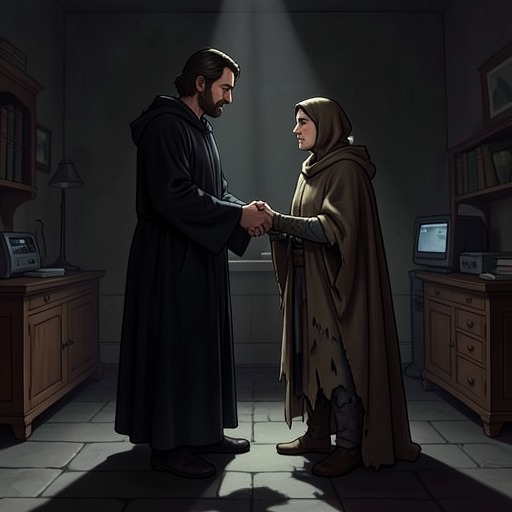
Avery’s message scroll, the court mage’s matching scroll, and the party’s portal orb enable Theo’s rapid return to the capital. Within ten minutes of putting on the magic-dampening handcuffs, he is transported to the courtyard and met by a dozen knights and the court mage. She orders him taken to the dungeons. Luc has remained silent since Theo confirmed the truth, and Theo cannot look at him as he is led away; Julius, Luc’s former lover, is among the guards and tells him that he will pay for hurting Luc.
The formal proceeding is staged as a spectacle of state power. Theo enters a crowded throne room with members of the court lining both sides, mirror spells displaying other meeting rooms, and the Hero’s party positioned opposite the throne. Syvia, the court mage, stands beside the haunting form of Eliza, while Veiv, Khal, Wicker, and Cargo watch Theo, Avery and Emi glare at him, and Bryony looks down at her feet. A round mirror above the throne broadcasts the scene to every town, village, and city in Algeya, making Theo’s humiliation and the court’s decision visible even in Leafel, the home he built around his work as a village healer.
Syvia announces the case as the trial of Healer Theo Bladefoot, revealed to be the host of the reincarnated Demon King, Malthios. The announcement provokes demands for immediate execution before King Alexis silences the room and insists that witnesses be heard. The proceeding thus presents itself as a trial, but its opening atmosphere reveals how little space the public initially grants to uncertainty: many spectators regard the identity of the host as proof of guilt before any evidence is considered.
The testimony divides the Hero’s party. Wicker, Veiv, and Khal emphasize that Theo helped them without hesitation, that Malthios harmed none of them when released, and that Theo saved Luc’s life twice. Avery stresses that Theo had seemed suspicious from the beginning, while Emi claims that he deliberately slowed the quest and allowed Tyraz to capture him too easily. Bryony says little, and Cargo is not called to testify. Luc’s evidence is brief because he was unconscious during much of the final battle, but his voice cracks while describing how Theo threw himself over him to block Tyraz’s blade before transforming. The testimonies make the central dispute concrete: Theo’s hidden identity is real, but so are the repeated acts by which he has chosen to protect the people now judging him.
Theo’s Defense and the Question of Two Souls
King Alexis asks whether Theo denies the party’s accusations or is Malthios. Theo answers that he denies neither the revealed facts nor his own identity as a host, but refuses the court’s attempt to collapse the two beings into one. He states that he and Malthios are two separate souls sharing one body, with one in control at a time. When the King asks why Theo did not surrender once he understood what he was, Theo points out that he was three years old when the truth became apparent and that Malthios was not then a danger to anyone.
Syvia proposes extracting Malthios from Theo and freeing him. Theo rejects the offer because he does not trust the court to avoid killing him, and because Malthios has told him that the two cannot be separated. Eliza challenges Theo for believing Malthios, exposing the deeper issue beneath the legal language: the court cannot accept a relationship in which Theo names, consults, and trusts the being it defines as an enemy. To the officials, calling Malthios by the familiar name Mal suggests dangerous sympathy; to Theo, that name records years of negotiated coexistence and the limits Malthios has accepted.
The trial also makes visible the asymmetry between Theo’s responsibilities and the authorities’ expectations. Theo is accused of protecting Malthios even though he has spent years restraining him, hiding him, and preventing his power from harming others. The court treats knowledge of the Demon King as sufficient grounds for suspicion, while Theo’s life in Leafel demonstrates a different standard of conduct: healing, community service, and chosen loyalty. His defense is therefore not an attempt to claim that Malthios never existed or never caused harm. It is an insistence that host, soul, intention, and action cannot be made interchangeable merely because the state requires a simple enemy.
Leafel’s Intervention and Luc’s Decision
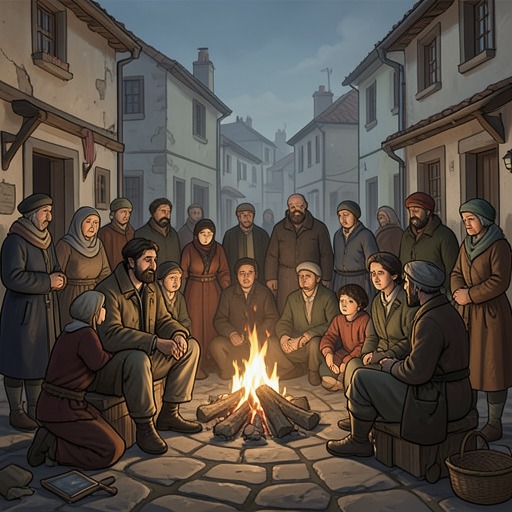
The proceedings turn when the court moves toward a guilty verdict. Theo’s anger gives way to fear that punishment will extend to Leafel; if the authorities attack the village, he believes its suffering will be his fault. Before Syvia can complete the judgment, light erupts beside her and a larger mirror spell opens. Through it, Theo sees Leafel’s town square filled with people: Micah stands at the front with his staff raised, joined by Imani, Dale, Dmitri and his parents, Nib, Amaya, and the rest of the village. Hayden steps forward, bows to the King and council, and declares that the people of Leafel demand Theo’s release.
The intervention overturns Theo’s expectation that discovery must end in abandonment. The village does not deny that he is Malthios’s host, nor does it attempt to erase the danger surrounding him. Instead, its people testify through presence. They place their knowledge of Theo’s daily conduct, healing, and belonging against the capital’s abstract image of a demonic threat. For Theo, their appearance is emotionally decisive: the people he feared he had endangered have come to defend him, proving that his chosen home is more than a refuge he built in secret.
King Alexis then clarifies the constitutional limit of the court’s authority. The fate of Healer Theo belongs solely to Hero Luca. Accusations that Luc is biased because he and Theo were lovers are answered by Eliza’s insistence that the Hero must place the world before personal feeling. Luc approaches Theo and asks to speak to Malthios directly. Malthios takes control, declares that he destroyed the Demon Fortress and all within it, and explains that only a few lesser demons and demon-created monsters may remain. Because the organized demonic threat has been broken, he says there is no longer any need for a Hero.
Luc nevertheless states the principle that governs his decision: as the Hero, it is his duty to kill the Demon King. The statement appears to confirm the death sentence, but Luc immediately adds that he also has the right to choose when that death will occur. The distinction between obligation and timing creates a narrow but vital form of mercy. Malthios remains condemned in principle, yet the execution is deferred indefinitely rather than performed at once. His appeal to Luc, made under the name Mal, recognizes both the legal authority of the Hero and the personal bond formed with Theo and his friends.
Verdict and Consequences
King Alexis announces the final judgment: Malthios is sentenced to life in prison, while Healer Theo Bladefoot is free of all charges. The decision preserves a distinction that the opening of the trial tried to erase. Theo is not legally punished for being the host, for sheltering Malthios under the conditions of their pact, or for refusing to surrender himself to authorities he believed might kill him. Malthios, meanwhile, is neither declared harmless nor executed; his existence remains subject to restraint and to Luc’s eventual judgment.
The verdict’s practical meaning is therefore more complicated than either acquittal or condemnation. Theo’s freedom recognizes the moral weight of his actions and the testimony of those he has saved. Malthios’s life imprisonment acknowledges the continuing danger associated with the former Demon King without requiring the state to sacrifice Theo’s life as a substitute punishment. Luc’s authority converts an immediate execution into a postponed sentence, making coexistence possible while leaving the unresolved question of whether a future threat will justify death.
The trial also changes the spatial and social balance between the capital and Leafel. The capital begins as a place that claimed Theo through testing, training, conscription, imprisonment, and public judgment. Leafel answers that claim through a magical projection of collective solidarity, turning the village itself into a political witness. When the proceedings end, Luc waves toward the people of Leafel through the mirror and says that, if the roads are clear, the party should arrive home before spring. The language of return is significant: Theo is not merely released from the court; he is publicly reattached to a home that has chosen him after learning the truth.
Narrative Significance
The Trial of the Demon King's Host is the story’s clearest collision between institutional identity and lived identity. The capital sees a category, the host of a reincarnated Demon King; Theo sees a negotiated shared body, a friendship formed through restraint, and a life defined by healing. The court’s questions focus on what Theo is, while the witnesses answer with what he has done. That contrast makes the trial less a search for hidden facts than a struggle over which facts are allowed to determine a person’s fate.
The event also reverses the expected logic of the Hero’s story. The Hero’s duty has been built around purging demons and protecting the common folk, yet Luc protects the common folk partly by refusing to kill Theo immediately. Theo, meanwhile, fulfills the protective role without belonging to the official Hero’s party and without surrendering his identity as a village healer. The judgment does not abolish the heroic system, but it exposes its limits: a law designed for an external enemy cannot easily account for two souls, one body, and a community that recognizes the host as more than the power within him.
Most importantly, the trial turns secrecy into public knowledge without allowing disclosure to dictate the final meaning of Theo’s life. He had expected that friendship would fail once the truth emerged, and the capital initially appears to confirm that fear. Yet the party’s testimony, Leafel’s intervention, and Luc’s postponed sentence establish a different possibility. Theo remains bound to Malthios, and Malthios remains condemned, but Theo is no longer alone in carrying the danger. The public ending makes chosen allegiance—not blood, origin, or official designation—the force that determines whether the host can return home.